

Most early-stage founders waste months building features nobody asked for. You ship, users don't engage, and you're left guessing why. Iterative development for early startups solves this by replacing guesswork with structured learning cycles. Instead of building a full product and hoping it lands, you test your riskiest assumptions in small, fast experiments. This guide walks you through the exact process: what to set up before your first iteration, how to run build-measure-learn loops that actually teach you something, and how to measure whether your changes are working.
Table of Contents
- Key takeaways
- What iterative development for early startups actually requires
- How to run iterative development cycles step by step
- Common pitfalls in iterative development and how to avoid them
- How to measure and validate your iteration outcomes
- My honest take on mastering iterative development
- How Robnishtech helps startups iterate faster
- FAQ
Key takeaways
| Point | Details |
|---|---|
| Test assumptions first | Define your riskiest hypothesis before writing a single line of code. |
| Keep cycles short | Iteration cycles of 1 to 2 weeks give you faster feedback and lower risk. |
| Measure real behavior | Use cohort retention and funnels, not signups or page views, to judge iteration success. |
| Avoid premature pivots | Wait for statistically meaningful data before changing your product direction. |
| Instrument before you build | Set up event tracking before launch so you can actually measure what changes. |
What iterative development for early startups actually requires
Before you run a single iteration, you need to be honest about what you don't know. Most founders skip this step and jump straight into building. That's where the waste starts.
The foundation of any successful iterative approach is identifying your riskiest assumptions. These are the beliefs your entire business depends on that you haven't yet proven. For example: "Users will pay $49/month for this feature" or "Small business owners spend more than 5 hours per week on this problem." If those assumptions are wrong, everything you build on top of them is wrong too.
The tools and mindset you need
Here's what you need in place before your first cycle:
- Customer interview practice. You should be talking to potential users weekly, not just at the start. The customer discovery process is iterative itself: define a hypothesis, talk to customers, test a solution, then refine or pivot based on what you learn.
- A clear hypothesis format. Write your assumption as a testable statement: "We believe [user type] will [do X] because [reason]. We'll know we're right when [measurable outcome]."
- Event instrumentation set up before launch. This is the one most founders skip. Founders often underestimate accurate event tracking before launch, and poor setup makes it nearly impossible to attribute outcomes to specific product changes.
- An MVP mindset. The minimum viable product is not a half-built product. It's the version that generates the most validated learning with the least effort.
Pro Tip: Before your first iteration, write down your top three riskiest assumptions and rank them by how badly the business breaks if they're wrong. Start there, not with the features you're most excited to build.
Key terminology at a glance
| Term | What it means in practice |
|---|---|
| Hypothesis | A falsifiable belief about your user, problem, or solution |
| MVP | The smallest build that tests your riskiest assumption with real users |
| Validated learning | Evidence from real user behavior that confirms or refutes a hypothesis |
| Pivot | A structured course correction based on what you learned, not frustration |
| Iteration cycle | One complete pass through build, measure, and learn |
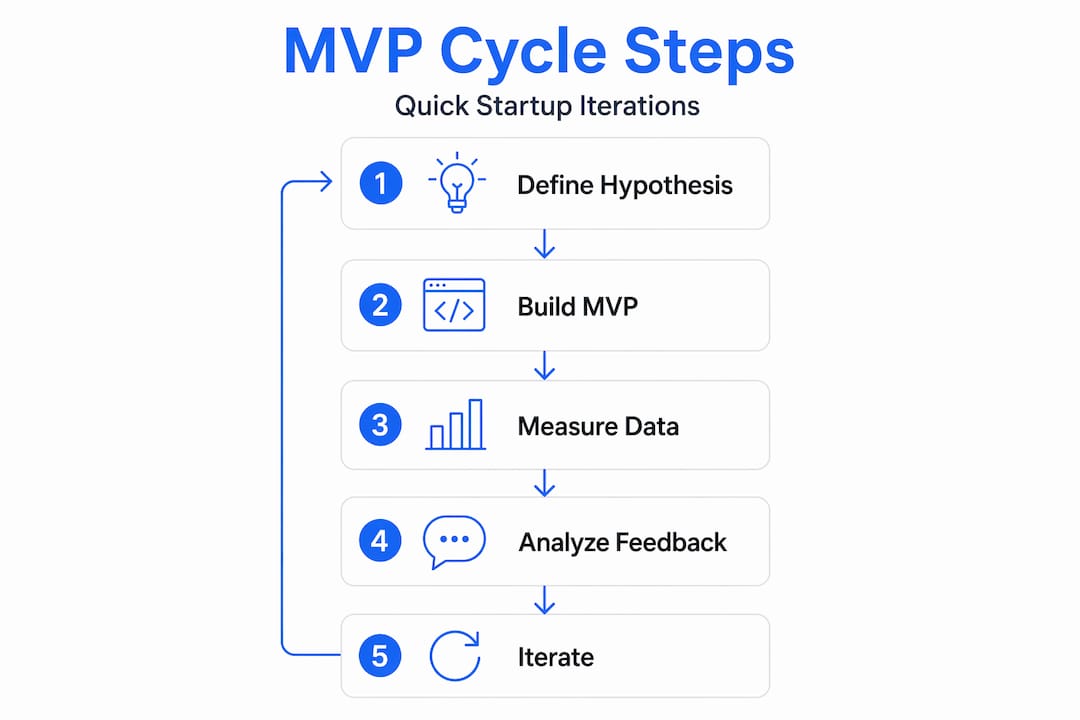
How to run iterative development cycles step by step
This is the part most guides gloss over. Here's the actual process, structured for early startups with limited time and resources.
-
Write your hypothesis. Be specific. "Users will complete onboarding" is not a hypothesis. "70% of users who sign up will complete profile setup within 10 minutes" is. The specificity is what makes it testable.
-
Design the smallest possible test. You're not building a product. You're building an experiment. Ask yourself: what's the minimum I can put in front of a real user to test this assumption? Sometimes that's a landing page. Sometimes it's a Figma prototype. Sometimes it's a manual process you run yourself before automating it.
-
Build with learning as the goal. Short MVP build cycles treat early releases as intentionally unpolished experiments designed to test assumptions with real users. The next iteration's scope is determined by actual user behavior, not a subjective sense of "done."
-
Measure real behavior. Look at what users actually do, not what they say they'll do. Signups and page views tell you almost nothing at this stage. Activation rate, time to first value, and feature adoption tell you whether your product is working.
-
Learn and decide. After each cycle, you have three options: persevere (the data supports your hypothesis), pivot (the data refutes it and you need a new direction), or refine (the data is directionally positive but you need to adjust). Don't make this decision based on gut feel.
-
Set your cadence and stick to it. Iteration cycles of 1 to 4 weeks reduce risk by delivering small increments with continuous customer feedback. For most early startups, 1 to 2 weeks is the right target. Longer than that and you lose feedback speed.
Pro Tip: A practical MVP cycle that works: spend one week building the core flow, then spend four weeks observing key metrics like signups and activation before deciding what to change. This 7-day SaaS MVP approach caps your risk while keeping learning fast.
The hardest part of this process is step five. Most founders either pivot too early (after one bad week) or too late (after six months of hoping things will turn around). Define your decision criteria before you start the cycle, not after you see the data.

Common pitfalls in iterative development and how to avoid them
Knowing the process is one thing. Executing it without falling into common traps is another. Here are the mistakes that derail most early-stage iterative efforts:
- Skipping the measure and learn phases. The biggest iteration mistake is building fast without designing cycles to falsify your riskiest assumptions. Speed without honest measurement is just expensive guessing.
- Using vanity metrics. Total signups, social media followers, and app downloads feel good but don't tell you whether your product is solving a real problem. Replace them with activation rate, retention at week 2, and revenue per user.
- Pivoting on insufficient evidence. One bad week is not a signal. One bad cohort might be. Wait until you have data from at least two to three iteration cycles before making a major directional change.
- Keeping cycles too long. If your iteration cycle is longer than four weeks, you're not iterating. You're doing mini-waterfall development. Shorten it.
- Ignoring qualitative feedback. Quantitative data tells you what is happening. Customer interviews tell you why. You need both to make good decisions.
- Poor event instrumentation. If you didn't set up your analytics correctly before launch, your measurement data is unreliable. Fix your event taxonomy before running another cycle, not after.
The discipline required here is real. It's genuinely hard to look at data that contradicts what you believed and act on it honestly. But that honesty is what separates startups that learn from ones that just ship.
How to measure and validate your iteration outcomes
Measurement is where most iterative development processes fall apart. Founders collect data but don't know what to do with it. Here's a practical framework.
Cohort retention analysis
Cohort retention analysis compares how different groups of users behave over time, grouped by when they signed up. If week 4 retention drops from 40% to 25% between two cohorts, that's a signal that something you shipped between those cohort windows hurt retention. This is one of the clearest ways to tie a specific release to a specific outcome.
Linking retention dips to specific releases and following up qualitatively with the worst-performing cohorts helps you target your next iteration correctly instead of guessing.
Funnel analysis
Funnels show you where users drop off in a specific sequence, like signup to activation to first purchase. Funnel event sequences reveal exactly where conversion breaks down. One critical detail: apply time limits to your funnels. Default settings can mix old and new user data, which inflates or distorts your results.
Pro Tip: Export your worst-performing cohort and send those users a three-question email survey. Ask what they expected, what they found, and what stopped them. You'll learn more from 10 responses than from a month of staring at dashboards.
| Metric type | Examples | What it tells you |
|---|---|---|
| Vanity metrics | Total signups, page views, app downloads | Surface-level activity, not product health |
| Actionable metrics | Activation rate, week 2 retention, revenue per user | Whether your product is actually working |
| Diagnostic metrics | Funnel drop-off points, cohort retention curves | Where and why users are leaving |
Comparing retention curves over time helps you identify onboarding or churn issues and guides what to prioritize in your next cycle. The goal is not to collect more data. It's to ask better questions of the data you already have.
My honest take on mastering iterative development
I've worked with enough early-stage founders to know that the problem is almost never speed. Most founders move fast. The problem is that they're moving fast in the wrong direction, and they've set up their process in a way that makes it impossible to notice.
What I've seen work, consistently, is founders who treat each iteration as a genuine experiment with a real hypothesis and pre-defined success criteria. Not "let's ship this and see what happens," but "we believe X, we'll measure Y, and if we don't see Z within two weeks, we're wrong." That shift in framing changes everything.
The counterintuitive lesson I keep coming back to: the startups that iterate best are not the ones that move fastest. They're the ones that are most honest about what the data is telling them. Validated learning requires intellectual honesty that most people find genuinely uncomfortable. You built something, you hoped it would work, and the data says it didn't. Acting on that clearly, without rationalization, is the actual skill.
Slow down your decision-making just enough to define your hypothesis before you build. Everything else gets faster as a result.
— Robin
How Robnishtech helps startups iterate faster
At Robnishtech, we build custom software for early-stage startups in Australia using the same build-measure-learn principles this guide covers. That means your MVP gets built with measurement in mind from day one, not bolted on afterward. Our startup development services are structured around short validation cycles, so you're never more than two weeks away from real user feedback. If you want to see exactly how we structure each phase, our development process walks through how we run discovery, build, and iteration stages with founders. Get in touch when you're ready to stop guessing and start validating.
FAQ
What is iterative development for early startups?
Iterative development is a product-building approach where you run short cycles of building, measuring, and learning to test assumptions before committing to full features. Each cycle produces validated evidence that guides your next decision.
How long should an iteration cycle be?
For early startups, 1 to 2 week cycles are ideal. Going beyond four weeks slows your feedback loop and increases the risk of building in the wrong direction.
What is the difference between a pivot and a refinement?
A pivot is a fundamental change in direction based on evidence that your core hypothesis was wrong. A refinement is a smaller adjustment when the direction is right but execution needs improvement. Both decisions should be driven by data, not emotion.
How do I know if my MVP is working?
Track activation rate, week 2 retention, and revenue per user rather than total signups. Cohort retention analysis is one of the most reliable ways to tell whether a specific release improved or hurt your product's performance.
What is the biggest mistake in iterative development?
Skipping the measure and learn phases after building fast. Moving quickly without honest data analysis means you're repeating mistakes instead of learning from them.