

Most business leaders assume that off-the-shelf software will handle their operations well enough. It works until it doesn't. The role of custom software in operations becomes undeniable the moment your team is running three separate platforms, manually reconciling data between them, and watching error rates climb as order volume grows. This guide breaks down exactly how custom software transforms operational efficiency, why scalability and integration matter more than most leaders realize, and how to measure the return on your investment with a framework you can actually use.
Table of Contents
- Key takeaways
- The role of custom software in operations efficiency
- Scalability and integration in complex organizations
- Measuring ROI and operational impact
- Practical steps for adopting custom software
- My take on what really drives results
- How Robnishtech helps operations teams build smarter
- FAQ
Key takeaways
| Point | Details |
|---|---|
| Custom software addresses real gaps | Off-the-shelf tools force workflow compromises; custom solutions are built around your actual processes. |
| Efficiency gains are measurable and fast | Case studies show 68% reductions in processing time within 12 months of implementation. |
| Scalability is built in from day one | Purpose-built software grows with your operations without forcing costly vendor-driven changes. |
| ROI follows a clear 3/6/12 month arc | Stabilization, throughput gains, and strategic capacity each emerge at predictable intervals. |
| Baseline data is non-negotiable | You cannot measure what you didn't track before go-live; define your metrics before development starts. |
The role of custom software in operations efficiency
Off-the-shelf software is built for the average business. If your operations are average, that's fine. But most scaling companies have workflows that don't fit neatly into a vendor's product roadmap, and that mismatch creates friction you pay for every single day.
The most common operational inefficiencies that custom software addresses include:
- Manual data re-entry between disconnected systems, which introduces errors and consumes hours of labor weekly
- Approval bottlenecks caused by workflows that don't match how your team actually makes decisions
- Reporting gaps where the metrics your business needs aren't tracked by your current tools
- Integration failures where two platforms technically connect but don't share the right data at the right time
Real-world results make the custom software impact on operations concrete. A 2026 manufacturing ERP implementation using a tailored Odoo build reduced order processing time from 4.2 hours to 1.3 hours, a 68% reduction, while improving inventory accuracy from 12.4% error rate to 1.8% and cutting month-end close from 12 days to 3. Those aren't marginal improvements. They change how a business operates at a structural level.
A wholesale distributor achieved even more striking results. After implementing a custom ERP and B2B portal, they tripled order throughput, improved stock accuracy from 82% to 99.2%, cut stockout events by 78%, and saved $200,000 annually by eliminating four redundant roles. Payback came in under seven months.
What drives these results isn't magic. It's automation of repetitive tasks, data integration that eliminates re-entry, and workflows designed around how your team actually operates rather than how a software vendor imagined you might.
Pro Tip: Before any custom build begins, spend two weeks mapping your five highest-volume workflows end to end. Count the manual steps, handoffs, and error-correction loops. That map becomes your baseline and your business case.
Scalability and integration in complex organizations
Generic software platforms are built to serve thousands of customers. That breadth is their strength and their limitation. When your operations grow, you hit ceilings that the vendor never designed you to break through, and workarounds become a permanent part of your team's day.
Purpose-built infrastructure is designed to scale from day one and integrate with your existing tech stack on your terms, not the vendor's. This matters for operations managers because it means you're not forced to change your workflows every time the vendor releases a new version or retires a feature.

The integration challenge is more expensive than most leaders anticipate. Commercial software APIs get deprecated. When a vendor sunsets an API version, every integration you built against it requires rework. API lifecycle management in custom solutions, where you control versioning, eliminates that recurring cost and the operational disruption that comes with it.
Here's what scalability actually looks like in practice for operations teams:
- A custom solution can add a new product line or business unit without requiring a new software license tier or a vendor-approved configuration change
- Reporting structures can be modified as your KPIs evolve, without waiting for a vendor's development roadmap
- User permissions and approval hierarchies can mirror your actual org structure, not a generic template
- Data models can be extended to capture new operational metrics as your business changes
Pro Tip: When evaluating any custom build, ask your development partner to document the integration architecture and API versioning strategy upfront. This single conversation prevents the majority of long-term maintenance surprises.
The advantages of tailored software solutions go beyond features. They give your operations team the ability to adapt without being held hostage to a vendor's priorities.
Measuring ROI and operational impact
The question every operations manager eventually asks is: how do we know this was worth it? The answer requires a framework, not a gut check.
A practical 3/6/12 month evaluation structure works like this. The first three months are stabilization. Your team is learning the system, edge cases are being resolved, and the data you're capturing is becoming reliable. Don't try to claim ROI yet. Month three to six is where throughput improvements become visible. Processing times drop, error rates fall, and you can start comparing against your pre-implementation baseline. Month six to twelve is where strategic capacity emerges. Break-even often occurs within 12 to 24 months, faster when automation is a core component of the build.
| ROI Phase | Timeline | Key Metrics to Track |
|---|---|---|
| Stabilization | Months 1-3 | System uptime, user adoption rate, data accuracy |
| Throughput gains | Months 3-6 | Processing time reduction, error rate, manual hours saved |
| Strategic capacity | Months 6-12 | New revenue enabled, roles reallocated, risk exposure reduced |
| Break-even | Months 12-24 | Total cost vs. cumulative operational savings |
The metrics that matter most for operations are manual reporting time, cycle time per transaction, error rate, and audit or compliance time. Off-the-shelf tools track what the vendor decided to track. Custom software tracks what your business actually needs to measure.
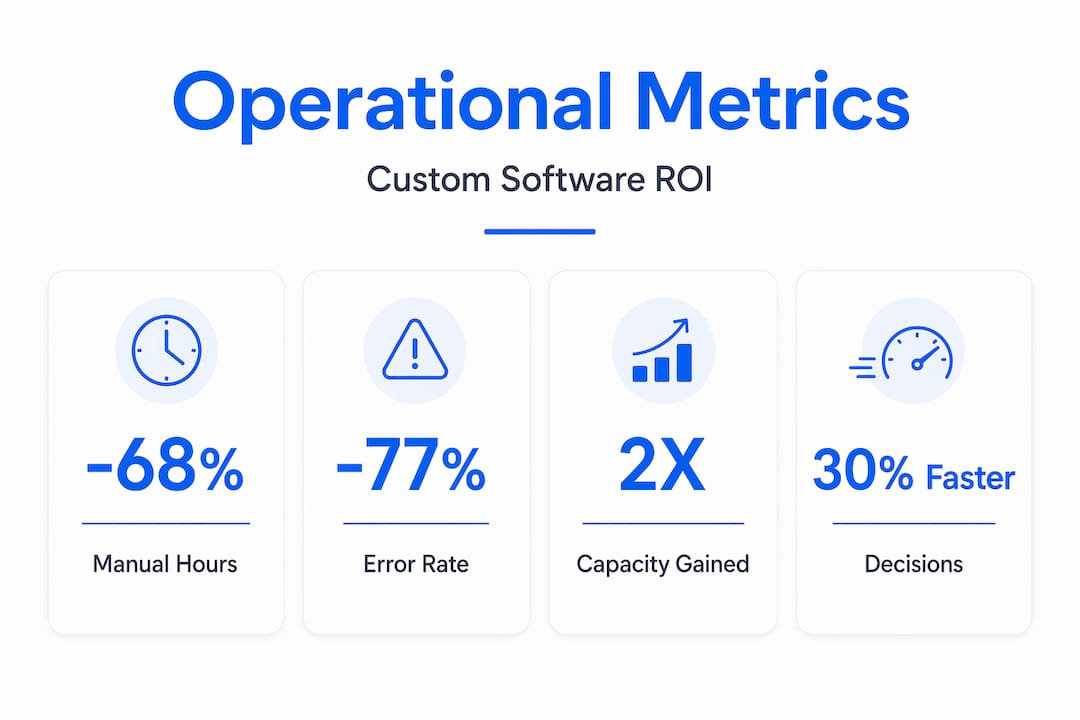
Beyond direct cost savings, custom applications deliver value through faster decisions, fewer costly errors, better staff retention from reduced frustration, and lower risk exposure. These show up in your P&L even when they're hard to attribute to a single line item.
Pro Tip: Design your data model and reporting layer around your ROI metrics before your development team writes a single line of UI code. This prevents the most common post-launch complaint: "We can't pull the report we actually need."
The biggest pitfall in ROI measurement isn't choosing the wrong metrics. It's failing to capture a clean baseline before go-live. Without pre-implementation data, every efficiency claim becomes a debate rather than a documented result.
Practical steps for adopting custom software
Knowing that custom software can transform your operations is one thing. Deciding when and how to move forward is another. Here's a structured approach that works for most business leaders evaluating this decision.
-
Confirm the case for custom over off-the-shelf. If your processes are genuinely unique, if you need deep integration with multiple existing systems, or if you're scaling faster than your current tools can handle, custom is worth serious evaluation. If your workflows are standard and your volume is predictable, a well-configured off-the-shelf solution may serve you adequately.
-
Capture your baseline before anything else. Document current processing times, error rates, manual hours per week, and cost per transaction for your highest-volume workflows. This data is your before picture and your negotiating tool with any development partner.
-
Choose a vendor with agile delivery practices. Waterfall development on a custom build is a high-risk approach for operations teams. Agile methodologies allow you to course-correct based on real user feedback before the full budget is spent. Ask potential partners how they handle mid-project scope changes.
-
Plan for change management from day one. The technology is rarely the hardest part. Getting your team to actually use the new system consistently, and to trust it, requires deliberate communication, training, and leadership buy-in. Budget time and resources for this explicitly.
-
Build integration maintenance into your ongoing budget. Silent integration failures are one of the most common hidden costs in custom software deployments. Set aside a portion of your annual IT budget for monitoring, updates, and API maintenance.
-
Evaluate the development partner's track record with operations-focused builds. A team that has delivered software for businesses with similar workflow complexity will anticipate problems you haven't thought of yet. Ask for case studies that include operational metrics, not just delivery timelines.
The how custom software improves efficiency question has a clear answer in practice: it removes the friction your team works around every day and replaces it with processes designed for how you actually operate.
My take on what really drives results
I've worked with enough operations teams to know that the gap between a successful custom software project and a disappointing one almost never comes down to the code. It comes down to two things that most leaders underestimate: baseline definition and change management timing.
The clients who see the clearest ROI are the ones who spent real time documenting their workflows before development started. Not a high-level process map. Actual step counts, handoff times, and error frequencies. When you have that data, the software gets built to solve real problems, and the results are defensible.
What surprises most clients is how long the stabilization phase actually takes. Three months feels like a long time when you've just invested in a new system and you're waiting to see results. But teams that try to claim ROI at week six, before the data is clean and the adoption is solid, end up in arguments with their finance departments. Patience in that first quarter pays off in credibility later.
The integration pitfalls are real too. I've seen well-built custom systems create unexpected maintenance costs simply because nobody budgeted for API updates when a connected third-party platform changed its structure. That's not a development failure. It's a planning failure. The highest returns from custom software come from teams that treat the software as a living operational asset, not a one-time project.
Build the reporting layer before the UI. Measure what matters. Give your team time to adapt. Those three things will determine whether your custom software investment looks like a success story or a cautionary tale.
— Robin
How Robnishtech helps operations teams build smarter
If you're at the point where your current tools are holding your operations back, the next step isn't another software evaluation spreadsheet. It's a conversation with a team that has built custom solutions specifically for growing businesses with complex operational needs.
Robnishtech specializes in AI-powered custom software development for startups and scaling companies across Australia. The approach is collaborative and iterative, meaning you stay involved at every stage and the software gets refined based on real operational feedback before full deployment. From automating manual workflows to building integrations that actually hold up over time, Robnishtech's development process is designed around your business KPIs, not a generic template. If you want software that delivers measurable operational results, reach out to Robnishtech to start the conversation.
FAQ
What is the role of custom software in operations?
Custom software addresses the specific workflow gaps, integration needs, and scalability constraints that off-the-shelf tools cannot solve without forcing costly compromises. It allows operations teams to automate processes, track the metrics that matter to their business, and scale without hitting vendor-imposed ceilings.
How long does it take to see ROI from custom software?
Most well-planned implementations show measurable efficiency improvements within six months, with break-even typically occurring between 12 and 24 months. Automation-heavy builds tend to reach break-even faster.
What are the main advantages of custom software vs off-the-shelf solutions?
Custom software gives you workflows built around your actual processes, integration control, and the ability to track business-specific KPIs. Off-the-shelf tools offer faster deployment but force workflow compromises and track metrics the vendor prioritizes, not necessarily yours.
How do you measure the operational impact of custom software?
Track metrics like manual hours saved per week, error rate reduction, cycle time per transaction, and new capacity enabled. Capture a clean baseline before go-live so every post-implementation comparison is based on documented data rather than estimates.
When does custom software make more sense than a standard platform?
Custom software is the stronger choice when your workflows are genuinely unique, when you need deep integration across multiple existing systems, or when your growth rate is outpacing what your current tools can handle without significant manual workarounds.